
What 3D Product Rendering Actually Is (and When to Use It)
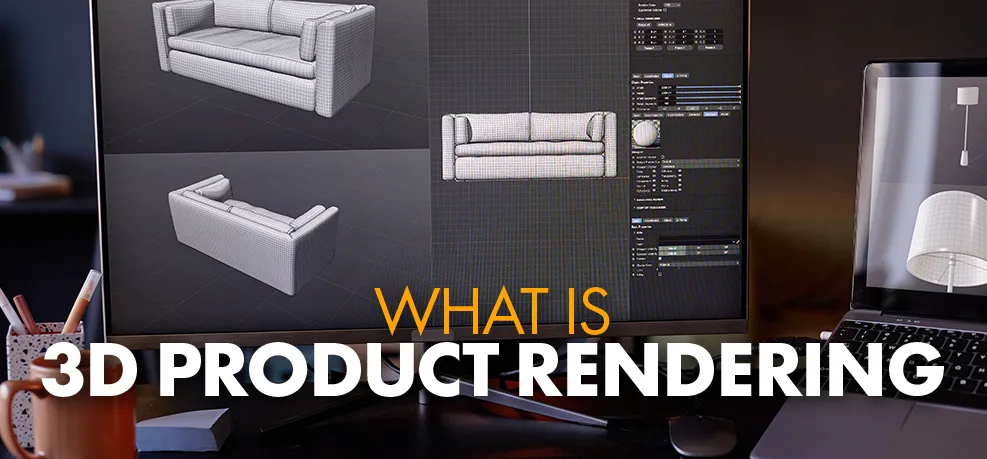
“3D product rendering” sounds more technical than it is. The idea is simple: instead of photographing a physical product, you build the product inside software as a digital model, give it materials and colours, light it, and let the computer produce an image of it. The result is a picture of your product that no camera ever took, because the thing in front of the lens never existed as a physical object in a physical studio.
Done well, you cannot tell. That is the part most people find hard to believe until they see their own product rendered beside a real photograph of it and cannot say which is which.
How It Actually Works
The process has a shape worth understanding, because it explains both what rendering is good at and what it costs.
First, the model. The product is built in three dimensions, accurate to its real proportions, from whatever reference exists: CAD files, technical drawings, or just photographs and measurements. This is the heavy lifting, and it happens once. Then materials and colours are applied, so the plastic reads as plastic, the foil as foil, the glass as glass. Then the scene is lit, exactly the way a photographer lights a set, except the lights are virtual and can go anywhere. Finally the software renders the image, calculating how all that light bounces around the model to produce a photograph-quality picture.
The important consequence: once the model exists, it is a reusable asset. A new angle, a new colourway, a new background, or a whole new pack variant is a small job, not another shoot.
Why It Now Looks Like a Photograph
Ten years ago, rendering was for things that could not be photographed, and it usually looked it. That has changed. For hard-surface products with clean geometry, cosmetics, packaging, electronics, bottles, containers, a well-made render is now genuinely indistinguishable from studio photography. The technology crossed a quality threshold, and the question stopped being “can it look real” and became “when is it the right tool.”
When a Brand Reaches for It
A few situations make rendering the obvious choice.
The product does not physically exist yet. You can show it, months before the first unit comes off the line, for a pitch, a pre-order page, or a retailer conversation.
You need many variations. I have built one model of a pack and produced every flavour, size, and colourway from it. Photographing each of those separately would mean a shoot per variant; rendering them means applying artwork to a model that already exists.
The packaging is not finalised. Brands use renders to see a pack in context and approve it before committing to a print run, which is a great deal cheaper than discovering the problem on a pallet of finished stock.
You are selling online. E-commerce rewards consistency, identical lighting and angles across a whole range, and renders deliver that far more reliably than a series of shoots on different days.
And sometimes the shot is simply impossible to photograph: a cutaway, an exploded view, a product floating in perfect light with no rig in sight.
When It Is Not the Answer
Rendering is not a religion, and it is not always the right buy. Organic textures like food, fabric, and skin are still hard to render convincingly, and lifestyle imagery with real people in real places often wants a real camera. It is also not automatically cheaper: the cost is front-loaded into building the model, so for a single image of a single simple product, a photograph can win. I have written a fuller comparison in 3D rendering versus photography, which is the piece to read if you are weighing the two for a specific project.
The Short Version
3D product rendering is photography’s more flexible sibling: slower and costlier to set up, then far cheaper and more controllable to run. It earns its place when a product does not exist yet, when variants multiply, when packaging needs approving before print, or when an online catalogue needs to look like one coherent range. If that describes what you are working on, that is exactly the situation 3D product rendering is built for, and I am happy to talk it through.