Call: +91-96741-50349

3D Product Renders for E-Commerce: Faster Listings, Better Images

If you sell products on Amazon, Flipkart, or your own online store, you already know this: the image is the product. A buyer scrolling through listings cannot pick up your package, turn it over, or feel the material. They have your images and nothing else. The quality, quantity, and consistency of those images directly determine whether someone clicks “Add to Cart” or scrolls past.
Most brands default to product photography for their listing images, and that works well. But for a growing number of products, 3D rendering offers a faster, more flexible, and more economical path to the same result, and in many cases, a better one.
I work with brands that sell through e-commerce platforms, and increasingly, the conversation starts not with “can you photograph this?” but with “can you render this before we have a physical sample?” The answer, for the right kind of product, is yes.
The E-Commerce Product Image Problem
A single product listing on Amazon or Flipkart typically needs seven to nine images:
- A hero shot on white.
- Multiple angles.
- A lifestyle image showing the product in context.
- An infographic overlay highlighting features.
- A close-up of the label or key detail.
- If the product comes in variants, each variant needs its own set.
For a brand with even a modest catalogue of twenty SKUs across a few colour or flavour variants, that adds up to hundreds of images.
Photography handles this, but the logistics scale linearly. Every variant needs a physical sample. Every sample needs to be shipped to the studio. Every setup takes time. Every reshoot costs money.
This is where 3D rendering changes the arithmetic.
Where 3D Rendering Changes the Equation: Speed
For products with straightforward geometry and existing packaging artwork, a single 3D model can produce every image a listing requires. Hero shots, detail angles, lifestyle contexts, infographic bases, all from one digital file.
Consider what this means in practice.
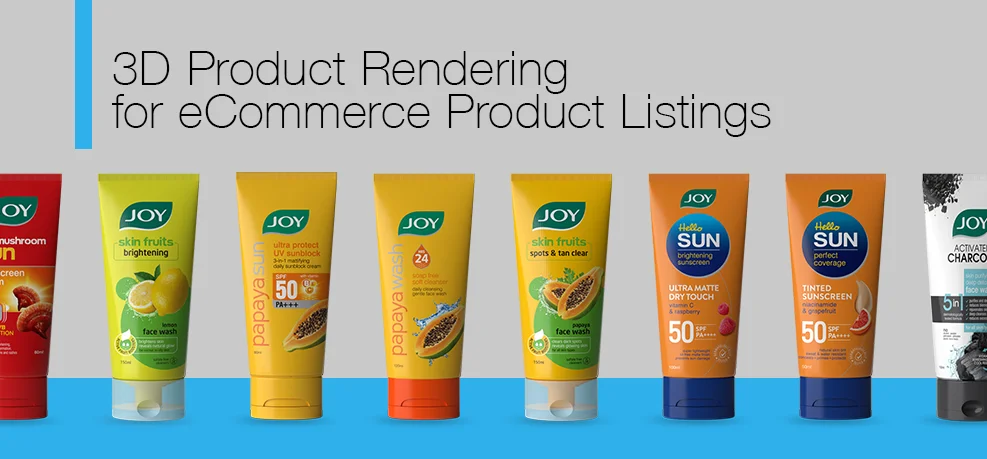
I recently worked on a range of cosmetic tubes for Joy.
- The process started with a wireframe model of the tube, built to the exact dimensions of the physical product.
- Once the base model was ready, the first variant was textured with the product’s packaging artwork and rendered in photorealistic detail.
- The second variant, a different product in the same range, required only a texture change.
- A third render placed the tube against a water-splash backdrop for lifestyle use.
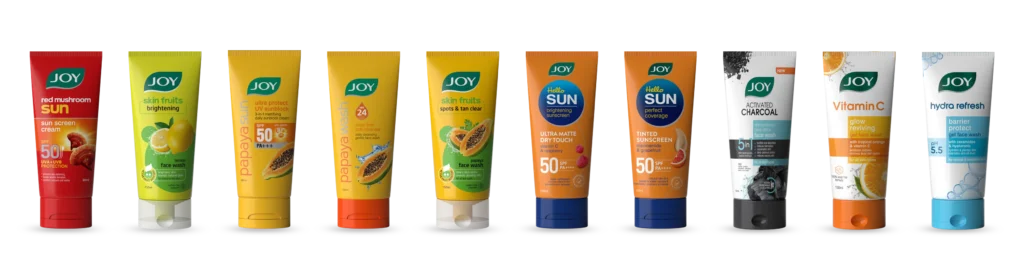
Three distinct, platform-ready outputs from a single model, with no physical samples, no studio, and no shipping. But at scale! Here are ten of the variants that I produced for Joy, but that’s just part of the whole brand story
The same approach worked for Mitrasena, an agricultural products brand. Their foil pouch was modelled once and rendered across variants, each with different label artwork, each to marketplace specifications.
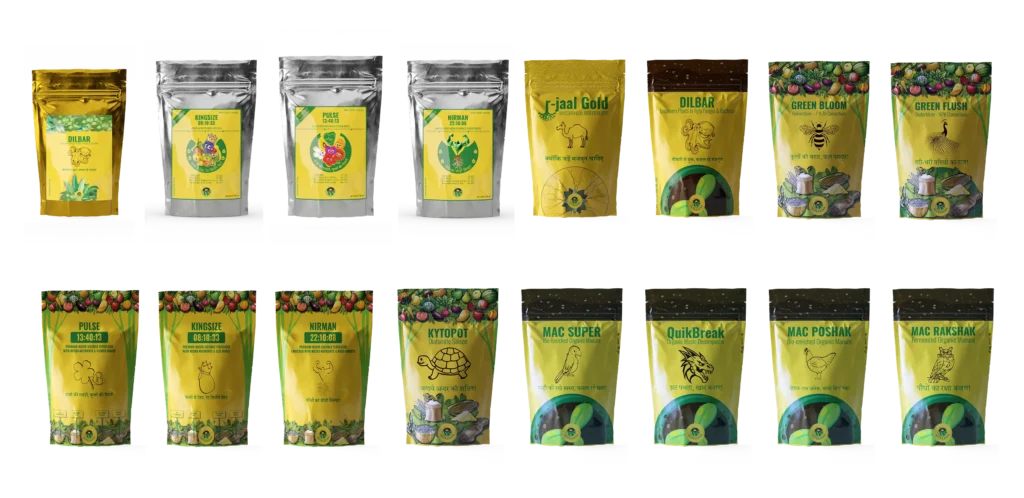
These are not approximations. A well-executed 3D render of a tube, bottle, box, jar, or pouch is visually indistinguishable from a photograph.
The lighting is controlled to the pixel. The reflections, shadows, and surface behaviour are physically accurate.
The output meets every platform requirement for resolution, background, and format. What’s not to like here? Every SMB and startup in India should be using this service for their products!
The Advantage of 3D Rendering Product Variants
This is where the economics of 3D rendering become genuinely compelling for e-commerce sellers.
A brand launching a skincare line in five variants, or a food product in eight flavours, faces a straightforward multiplication problem with photography. Five variants means five sets of samples, five setups, five rounds of post-production. If the brand updates its packaging artwork six months later, perhaps a regulatory change, a new ingredient callout, or a seasonal edition, the process repeats.
With 3D rendering, the base model already exists. A new variant means swapping artwork files, adjusting a colour value, or changing a material finish. The rendering environment, lighting, camera angles, and scene composition remain identical. Each new variant is produced in a fraction of the time and at a fraction of the cost of a fresh photoshoot.
More importantly, that 3D model is a reusable digital asset. It does not expire. When the brand needs a new angle for a promotional campaign, an updated hero image for a platform redesign, or a lifestyle render for social media, the model is ready. No rebooking, no reshipping, no re-setup. Or what if you want to upgrade from static images to animated video, like the splash effect video I created for Joy Cosmetics – shared below!
Product Image Consistency Across the Catalogue
There is a subtler benefit that matters more than most brands realise.
When a brand’s Amazon or Flipkart store displays products in a grid, visual consistency signals quality and professionalism. Identical lighting across every SKU. Identical shadow direction. Identical colour temperature. Identical camera distance and angle. When that breaks, the brand’s identity is tainted.
Achieving this consistent look across multiple photography sessions is difficult. Different days, different ambient light, different setups, even minor variations in post-production, all introduce inconsistencies that become visible when products sit side by side on a screen.
3D renders from a single scene file are pixel-perfect consistent. Every product in the catalogue shares the same virtual studio, the same light rig, the same camera. The brand’s store page looks like it was planned as a cohesive visual system, because it was. It’s no wonder that large brands have been doing this for years, and the buyer has never known.
When 3D Product Renders Work Best, and When They Do Not
This approach suits certain products better than others, and it is worth being specific about that.
Ideal for 3D rendering
- FMCG packaging with printed artwork: boxes, cartons, pouches, sachets
- Cosmetics and personal care: tubes, bottles, jars, compacts
- Beverages: bottles, cans, tetra packs
- Consumer electronics: product housings, device shells, accessories
- Any product where the form is geometric and the surface is a printed, painted, or uniform material
Better served by photography
- Textured fabrics, knits, and woven materials where tactile quality sells
- Food products where the actual appearance of the food matters
- Handmade or artisanal items with unique, irregular surfaces
- Products where the buyer needs to see the real item for trust reasons
For a more detailed comparison of when to choose 3D rendering over photography, I have written about this separately in my post on 3D product rendering vs photography.
When Design and 3D Rendering Work Together
There is one further advantage worth mentioning, because it applies directly to how I work.
Many of the products I render for e-commerce are products whose packaging I also designed. The artwork files already exist in the formats needed for texturing the 3D model. The dieline dimensions are already built into my workflow. The colour specifications, material finishes, and print-ready details are all decisions I made during the design phase.
This eliminates the handoff that usually sits between a packaging designer and a 3D rendering studio. No file conversion, no misinterpreted bleeds, no back-and-forth about how a metallic foil should catch the light. The design intent carries through to the render without friction.
If you are working with separate teams for packaging design and product visualisation, the process still works well. But if having both under one roof appeals to you, my 3D visualisation services and design services are built to work together in exactly this way.
If You Are Listing Products on E-Commerce Platforms
If you are preparing to launch your product range on Amazon, Flipkart, or your own online store, or if your existing listings need stronger product images, 3D rendering may be a faster and more cost-effective route than you expect. This is especially true if your products fall into the categories above and if you already have packaging artwork ready to go.
Get in touch here to discuss whether this approach fits your catalogue. You have nothing to lose.