Call: +91-96741-50349

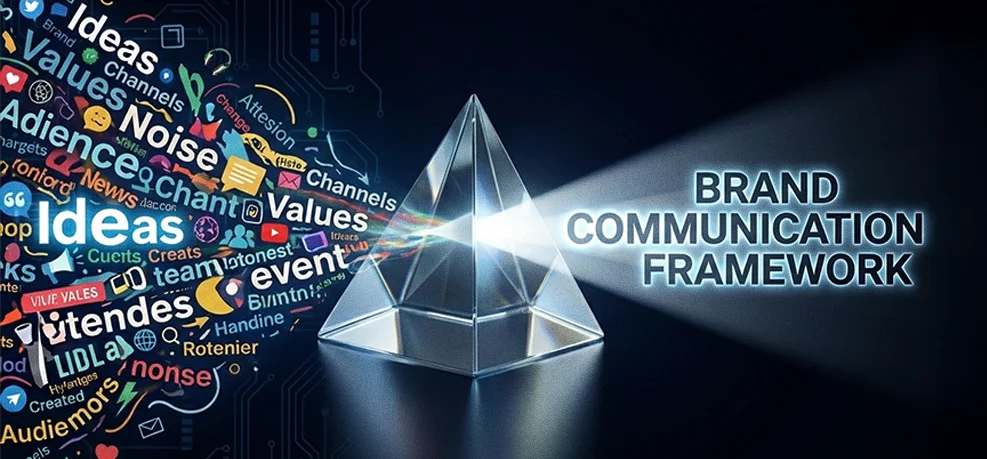
What a Brand Communication Framework Actually Looks Like

Everyone talks about “brand strategy.” Few explain what the deliverable actually is. What do you walk away with?
Clients hear “brand communication framework” and imagine either something vague and conceptual, or a 200-page document no one reads. Neither is useful.
This post shows what a practical brand communication framework contains – the components that actually guide day-to-day decisions about how your brand speaks.
One clarification upfront: this is brand communication strategy, not business strategy or market positioning. It’s the layer between who you are and how you express it – the verbal equivalent of your visual identity.
By the end, you’ll understand what you’re buying when you commission this work, and whether your brand actually needs it. Psst: We build Brand Communication Frameworks as a service.
First, Let’s Clear Up the Confusion
What a brand communication framework IS:
- A documented system for how your brand communicates
- The foundation that every writer, designer, and agency needs to represent you correctly
- Practical guidance that shapes real decisions
What it IS NOT:
- Business strategy (market positioning, competitive strategy, pricing)
- A one-time campaign concept
- A static document that never changes
A note on visual identity and taglines: Whether these sit inside or outside your communication framework depends on what already exists when the work begins. If your visual identity and tagline are established, they absolutely belong in the framework – as reference points that keep communication on-brand. They represent personality and what the brand stands for. If they don’t exist yet, the framework might inform their creation. The relationship isn’t fixed; it depends on where your brand is in its journey.
The framework sits in the middle of a larger system: Business strategy → Brand communication framework → Visual identity + Verbal identity → All executions (ads, website, social, and so on). It translates business positioning into communication principles.
What’s Actually in the Brand Communication Framework Document
1. Brand Voice
The personality of the brand when it speaks. This stays consistent regardless of channel or context – whether you’re writing a homepage headline or responding to a complaint.
Voice is usually defined as three or four characteristics with explanations. A useful structure: “We are [X], which means we [behaviour]. We are not [opposite].”
2. Tone Variations
Voice stays constant; tone adapts to context. How does the brand sound in different situations?
Formal contexts versus casual ones. Celebratory moments versus problem resolution. Social media versus legal documents.
For example: “In support contexts, we lead with solutions, not just apologies. If there are apologies, they’re accompanied by what we’re doing to fix it.”
3. Messaging Architecture
The core message or brand promise – the single most important thing. Supporting messages – proof points, key benefits. How these ladder up and relate to each other. Audience-specific variations if relevant.
This is the backbone. Everything else hangs off it.
4. Language Principles
Words we use. Words we avoid. Sentence structure preferences – short and punchy, or flowing and warm? Jargon policy – do we use industry terms or translate them for our audience? How we talk about competitors (or don’t).
5. Proof Points and Boilerplate
Approved ways to describe the company. Key facts and statistics that can be cited. Standard descriptions at different lengths – one line, one paragraph, one page.
What This Looks Like in Practice
Let me share a real example, simplified.
When working with MitraSena – a brand in the agricultural sector – we initially thought the best approach would be through a character called Dr Green. He would know what he was talking about and tell farmers what to do. Authoritative. Expert. Clear.
Along the way, we realised farmers were responding better to a friend than a doctor. They engaged more with someone speaking with them rather than to them. Discussion, not instruction.
So we changed course. Not a doctor, but a knowledgeable friend – someone who has done his research but is open to new ideas, thoughts, and learnings. This also fit beautifully with the brand name: MitraSena. Friend.
The point? Brand communication is essential to have in place, but it should not be a stagnant entity. It keeps evolving with the brand. The framework guides; it doesn’t constrain.
What Happens Without a Communication Framework
Problems that emerge without a framework:
Every piece of content sounds different. New team members or agencies have to guess. Feedback becomes subjective – “I don’t like it” rather than “This doesn’t match our voice because…” The brand feels inconsistent to customers, even if they can’t articulate why.
What changes with a framework in place:
Anyone writing for the brand has a reference. Feedback becomes objective and faster. Consistency builds recognition and trust. Onboarding new writers and agencies becomes dramatically easier.
Is This Actually Necessary for Your Brand?
You probably need this framework if:
- Multiple people create content for your brand
- You’re onboarding agencies or freelancers regularly
- Your brand communications feel inconsistent
- You’re going through a rebrand or significant growth phase
- You keep having subjective arguments about tone
You might not need a communication framework if:
- You’re a solo operator who writes everything yourself
- Your brand is very new and still finding its footing – sometimes it’s premature to codify
- You have a very simple, single-channel presence
Honest note: not every business needs a formal framework. But if you’re scaling, hiring writers, or working with agencies, the cost of NOT having a formal Brand Communication Framework adds up fast in revision cycles and inconsistency.
What Clients Expect vs What They Actually Need
Here’s something worth saying directly.
The average client has been so conditioned by the way most agencies approach briefs that they expect a boxes-ticked list of deliverables. A corporate vision paragraph. Check. A brand personality paragraph. Check. Templates filled in. Safe. Familiar.
What they actually need – and usually know it, even if they’re wary of admitting it – is relevance. Solutions. Not templates.
Which is why each brief should be addressed uniquely, with frameworks acting as approximate guidelines rather than rigid structures. What the client really needs is a communication partner who understands their brand almost as well as they do. After that, the rest follows.
The best moments in this work? When something emerges that wasn’t on the expected list of deliverables. When it changes the whole direction because it opens up new avenues. When everything that came before gets willingly set aside by both parties because something better appeared.
That’s when we, at Nabina Ghosh Creative Services and Ideas, know that the framework is working – not as a constraint, but as a foundation for discovery.
How We Develop the Brand Communication Framework
A brief overview of the typical process in developing your Brand Communication Framework:
- Discovery – understanding the business, audience, and existing materials. This is more conversation than questionnaire. The right questions emerge from the discussion, not from a predetermined list.
- Audit – reviewing current communications, identifying inconsistencies, understanding what’s working and what isn’t.
- Definition – drafting voice, tone, and messaging architecture. Testing ideas. Refining.
- Refinement – testing against real scenarios, getting stakeholder input, pressure-testing the framework against actual use cases.
- Documentation – creating the usable reference document that lives beyond the project.
How Long Does This Take? The Timeline Varies
Developing the framework typically takes three to six weeks depending on complexity and stakeholder availability.
What’s Needed From the Client:
To be able to create a comprehensive Business Communication Framework, we would need access to existing materials, stakeholder time for interviews and feedback, and clarity on who approves the final output.
A Living Document, Not a Monument
A brand communication framework isn’t a luxury or a vanity project. It’s a practical tool that makes every piece of communication easier to create and more consistent in execution.
But it’s also not a bible to be followed without question. Markets change. Audiences evolve. Brands grow. The framework should grow with them.
If your brand is scaling, if multiple people touch your communications, or if you’ve ever found yourself unable to explain why a piece of copy “doesn’t feel right” – a Brand Communication Framework gives you the vocabulary and structure to fix that. We can help you with that.
And if the framework itself needs to evolve along the way? That’s not failure. That’s exactly how it should work.
If you’re considering building a formal Communication Framework for your brand, I’m happy to discuss whether it’s the right investment for your situation.
Learn more about our brand communication strategy services →